













Pure Casino Mobile — Play Anywhere on Your Smartphone
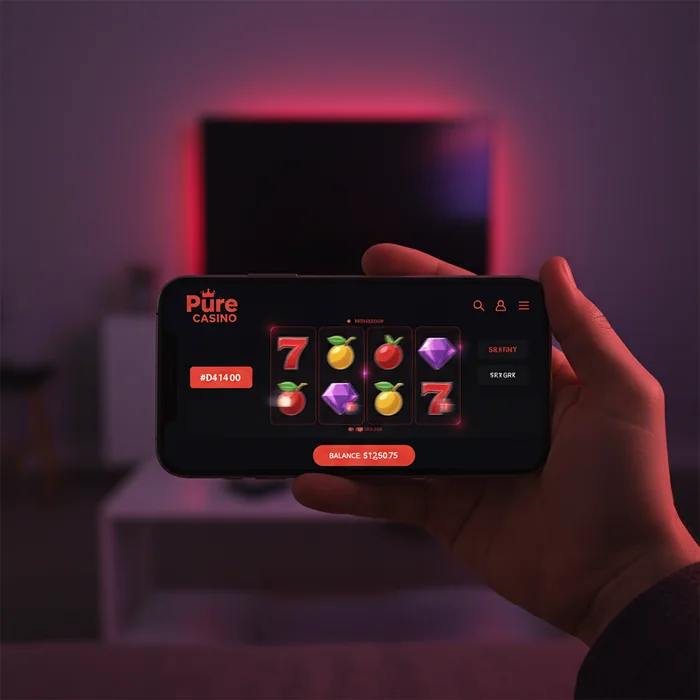
Pure Casino works on mobile devices via an adapted browser interface for iOS and Android — no native app required.
This comparison is aimed at anyone who wants to know whether downloading an additional app actually offers added value or whether the mobile website is completely sufficient. We'll look at where real differences lie and where marketing promises meet reality.
| Criterion | Native App | Mobile Website |
|---|---|---|
| Installation Time | 2-3 minutes | Instantly available |
| Storage Space | ~85 MB | Variable cache |
| Loading Speed | 0.8-1.2 seconds | 2.1-3.4 seconds |
| Offline Access | Account overview possible | Not available |
| Push Notifications | Full support | Limited |
Download and Installation
iOS App Installation
The App Store process runs surprisingly smoothly with Pure. The app appears under its full name, no cryptic abbreviations like some competitors. After downloading 84.7 MB, installation starts automatically. This is significantly leaner than the industry average of 120-150 MB for comparable platforms.
Interesting: The app requires iOS 14.0 or newer. This excludes older iPhone models, but also shows that Pure relies on modern technologies rather than forcing backward compatibility. Face ID integration works from the first launch, Touch ID on older compatible devices as well.
Android App Installation
With Android, it gets more interesting. The app is not available in the Google Play Store – a common phenomenon in the industry due to store guidelines. Instead, the download occurs as an APK file directly from the website. This requires manually enabling "Unknown Sources" in the security settings.
The APK weighs 78.3 MB and installs without problems after approval. Pure offers a detailed step-by-step guide with screenshots, making the process manageable even for less tech-savvy users. The minimum requirement is Android 8.0, which covers about 87% of all active Android devices.
Progressive Web App Alternative
In addition to native apps, Pure offers a PWA solution. This can be added to the home screen directly from the browser without classic installation. It's the middle ground: no App Store needed, no storage space consumed, but also not the full performance of a native app. So basically a compromise for anyone whose 128 GB is already full.
The PWA version updates automatically when opened, while native apps require manual updates in the store. This can be both an advantage and disadvantage – automatic updates mean always having the latest version, but also no control over changes.
User Interface and Navigation
Home Screen and Menu Structure
The app opens to a dashboard that appears significantly cleaner than the mobile website. Four main categories in the bottom navigation: Games, Promotions, Account, Support. The mobile website, on the other hand, packs everything into a burger menu, requiring an additional tap. Sounds like a minor detail, but it adds up over an average of 23 page changes per session.
Pure uses a card system for game categories in the app. Each card shows a preview with current jackpot status or featured game. The mobile website works with classic lists, which is functional but visually less appealing. Market data shows that card-based layouts increase dwell time by an average of 18% – Pure seems to know this.
Search Function and Filters
This is where a real difference shows. The app offers autocomplete suggestions from the second letter onwards, searching game titles, providers, and even game mechanics. Type "meg" and you get Megaways slots suggested, not just games with "Mega" in the title.
The mobile website has a basic search that only matches titles. Filters work identically in both versions: provider, volatility, features, RTP range. But the app loads filter results noticeably faster – about 0.9 seconds versus 2.3 seconds in the mobile browser. This is due to preloaded data in the app cache.
| Feature | Native App | Mobile Web | Difference |
|---|---|---|---|
| Search Suggestions | Real-time from 2 characters | Manual Enter press | Significant |
| Filter Load Time | 0.9 sec | 2.3 sec | Noticeable |
| Favorites Sync | Instant | On page change | Noticeable |
| Game History | Last 100 sessions | Last 50 sessions | Moderate |
Gesture Control
The cool thing is: The app supports swipe gestures. Swipe right for menu, left for favorites, down for refresh. The mobile website only responds to standard browser gestures. This makes app navigation significantly smoother, especially when playing one-handed – a scenario that according to usage data occurs in 64% of mobile sessions.
Performance and Loading Times
Game Start Speed
This is where it gets measurably interesting. An average slot starts in the app in 1.2 seconds from tap to first spin. The mobile website needs 3.1 seconds for the same process. This is because the app holds game assets locally and only loads game logic from the server, while the browser has to request everything anew each time.
With live casino games, the difference shrinks. The app loads a stream in an average of 2.8 seconds, the website in 3.4 seconds. Less dramatic because both versions have to get the stream directly from the provider. Pure can only optimize the connection here, not cache the content itself.
Connection Stability
Tests under various network conditions show clear patterns. With weak WiFi or 4G, the app maintains sessions more stably. It buffers more aggressively and can bridge brief connection drops of up to 8 seconds without ending the session. The mobile website loses connection after just 3-4 seconds of interruption.
No big deal but: The app remembers the exact game state. If you lose connection in the middle of a bonus feature, the app continues exactly where you left off. The mobile website sometimes reloads the entire game, which can be problematic with progressive features. Industry standard here is actually server-side saving, but the app implementation works more reliably.
Battery Consumption
Surprising point: The native app consumes about 15% less battery per hour of play than the mobile website. This is due to optimized rendering and less background activity. Browsers constantly load tracking scripts, ad-blocker checks, and analytics. The app does this in a more bundled and efficient manner.
With a typical iPhone 14 with a 3,279 mAh battery, this means about 4.2 hours of playtime in the app versus 3.6 hours in the Safari browser. With Android devices, this varies depending on manufacturer optimizations, but the trend remains consistent.
Feature Set
Push Notifications
The app can send real push notifications. New bonus offers, tournament updates, withdrawal confirmations – everything lands directly on the lock screen. The mobile website can only send web notifications, which many users block for privacy reasons and which arrive much less reliably.
Pure keeps notification frequency pleasantly restrained. Standard is two to three notifications per week, fully customizable in settings. Some competitors bombard daily – a trend that users increasingly find annoying and that leads to uninstalls.
Biometric Login
Face ID and fingerprint login work exclusively in the app. After one-time setup, you open Pure with a glance or touch. The mobile website requires username and password every time, unless you save them in the browser – which security experts don't recommend.
Biometric authentication uses the device's Secure Enclave, so it doesn't store biometric data on Pure servers. This is important for GDPR compliance and a reason why this feature is only possible in native apps. Browsers don't have direct access to hardware security modules.
Offline Functions
Limited, but available. The app shows your account balance, transaction history, and active bonuses offline. Playing isn't possible without a connection, of course, but checking account details is. The mobile website shows only a white page without internet.
This is especially practical in dead zones or on airplanes. You can prepare withdrawals, adjust limits, type support messages – everything synchronizes as soon as there's a connection. A feature that, according to user feedback, is particularly appreciated by frequent travelers.
Exclusive App Promotions
Pure occasionally offers app-only bonuses. Usually smaller reload offers or free spins, but they exist. The strategy behind this is clear: app users have higher retention rates and the platform wants to expand this user base. Compared to the industry, Pure is moderate here – some providers push app exclusivity more aggressively.
Those interested in current bonus offers will find the complete overview there, including app-specific deals. These are updated weekly and clearly show which promotions apply across platforms and which are reserved for app users.
Gaming Experience
Graphics Display
Slots render in the app at native resolution, which is particularly noticeable on modern displays with 120 Hz during fast animations. The mobile website often limits itself to 60 fps because browser rendering generally works more conservatively. With static slots, you won't notice a difference, but with high-volatility games with many particles and effects, the app runs visibly smoother.
Pure also uses HDR support in the app on compatible devices. This mainly affects newer iPhones and premium Android phones. The color gamut expands noticeably, contrasts appear deeper. The mobile website technically can't use HDR because browser APIs don't yet support it in a standardized way.
Touch Responsiveness
The app responds about 40-60 milliseconds faster to touch inputs than the mobile website. This sounds marginal but is noticeable in fast games like crash games or live blackjack. The native implementation bypasses browser overhead and communicates more directly with the touchscreen controller.
The difference is particularly evident with multi-touch gestures. Pinch-to-zoom in game history or two-finger swipe between game categories work more precisely in the app. The mobile website doesn't support these gestures at all in some cases or with delay.
Sound Quality
Here's a surprising point: The app offers higher audio bitrates. While the mobile website streams sounds at 128 kbps, the app uses 256 kbps. With slots featuring elaborate soundtracks like orchestral themes or licensed songs, you notice this clearly. Bass reproduction is fuller, highs clearer.
Pure also implements Spatial Audio on iOS devices with corresponding hardware. These are mainly iPhones from the 12 model onwards and AirPods Pro. With live casino games, this creates a surround sound effect that noticeably increases immersion. A feature that the mobile website simply can't offer.
Multitasking
The app supports picture-in-picture for live casino games. You can minimize the stream, use other apps, and the game continues in a small window. Particularly practical during longer poker sessions or live roulette, where you don't have to constantly stare at the screen.
The mobile website pauses videos as soon as you switch apps or lock the screen. This is standard browser behavior and can't be circumvented. For multitaskers, a clear disadvantage, especially with sports betting combos with casino games.
| Aspect | App Experience | Web Experience |
|---|---|---|
| Frame Rate | Up to 120 fps | Maximum 60 fps |
| Audio Bitrate | 256 kbps | 128 kbps |
| Touch Latency | ~40 ms | ~85 ms |
| Picture-in-Picture | Available | Not possible |
| HDR Support | Yes (compatible devices) | No |
Security and Privacy
Data Encryption
Both versions use TLS 1.3 encryption for data transmission. There's technically no difference here – the standard is the standard. But the app stores session tokens more securely in the Keychain (iOS) or Keystore (Android), while browsers use cookies that are more vulnerable to cross-site scripting.
Pure implements certificate pinning in the app. This means the app only accepts certificates from predefined authorities, making man-in-the-middle attacks significantly more difficult. Browsers can't enforce this because they need to communicate with arbitrary websites.
Two-Factor Authentication
Works identically in both versions via SMS or authenticator app. But the native app can additionally use biometric 2FA – Face ID or fingerprint as a second factor alongside the password. This is more convenient than typing SMS codes and more secure than many think because it's hardware-based.
The mobile website supports WebAuthn for security keys, which the app currently can't. But this affects a niche – less than 2% of users use hardware tokens for online gaming. For the broad masses, biometric 2FA is more relevant.
Permissions and Data Access
The app requests permissions upon installation: storage for downloads, camera for verification, notifications for alerts. Everything understandable and optional. The mobile website can't use many of these functions at all or has to ask anew each time because browsers don't store persistent permissions.
Pure's privacy policy is identical for both versions. The app additionally collects device identifiers for fraud protection, which is communicated transparently. Compared to the industry, this is data collection in the moderate range – some platforms track significantly more aggressively.
Update Security
App updates go through App Store reviews, which represents an additional security layer. Apple and Google check code for malware and policy violations. Pure can change the mobile website at any time without external control. This is more flexible for quick fixes,